# Automated Workflow For Customer Signup

<table><thead><tr><th width="184">Automation Type </th><th>Description</th><th width="242.199951171875">Why should you send a message ?</th><th>Example message</th></tr></thead><tbody><tr><td>New Customer Sign up</td><td>Triggered when a user successfully completes the signup form.</td><td>Confirms successful account creation and welcomes the user, establishing the brand's tone and first impression.</td><td><em>“Welcome to [Brand Name], [First Name]! Your account has been created successfully.”</em></td></tr></tbody></table>

***

### New Customer Signup Template

This section covers the use case of sending an automated WhatsApp / SMS message when a **new customer signs up** on your Wix website and the steps involved in setting up the workflow.

### Use case: Welcoming New Users

{% embed url="<https://youtu.be/4yIS6pzN9eo>" %}

<mark style="color:blue;">**To learn how to set up SMS automation for new customer sign-ups**</mark><mark style="color:blue;">,</mark> [<mark style="color:blue;">**click here**</mark>](#video-resources)

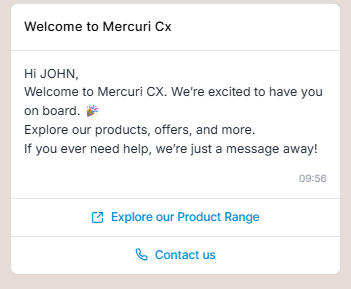
When a new user signs up via the Wix website, the system should send a WhatsApp / SMS  message containing:

* Welcome message
* Customer name
* Brand/store name
* An optional button to explore or start shopping

<figure><img src="/files/CfCReVilcPhV5e3zHaCt" alt=""><figcaption><p>New User Signup Templates</p></figcaption></figure>

## Steps involved in setting up an Automated Workflow

{% hint style="info" %}
If you have already set up the WhatsApp / SMS template for the **New customer sign-up** event, then jump to this [section](#b.-adding-the-whatsapp-sms-template-to-the-automated-workflow).&#x20;
{% endhint %}

<details>

<summary><mark style="color:blue;"><strong>A .1.  Setting up the WhatsApp Template</strong></mark></summary>

1. **Navigate to WhatsApp Templates**

<figure><img src="/files/SFuB5eiJN1zMtMmrWo02" alt=""><figcaption><p>Step 1  : <strong>Navigate to WhatsApp Templates</strong></p></figcaption></figure>

&#x20;1\. Go to **Templates > WhatsApp** in the Mercuri CX dashboard.

2. Click **Create Template**.

3. Select the **WhatsApp Account** that will be used to send out WhatsApp messages.

4. **Configure Template Details**

<figure><img src="/files/XdaflVH6qIVNEKhEb4SV" alt=""><figcaption><p>Step 2 : Configure Template Details</p></figcaption></figure>

**Fill in the basic template info:**

* **Template Name:** `New_signup_welcome` (Use an easy name to identify later)
* **Language:** `English` (or as per your customer base)
* **Category:** `Marketing` (since it's promotional in nature and welcoming)

\[ [*Understand the different categories of WhatsApp templates*](https://docs.mercuri.cx/features/automations/pages/y1Hhk9EVYdDwzdINHEqz#id-1.-template-category)]

3. **Fill Template Components**

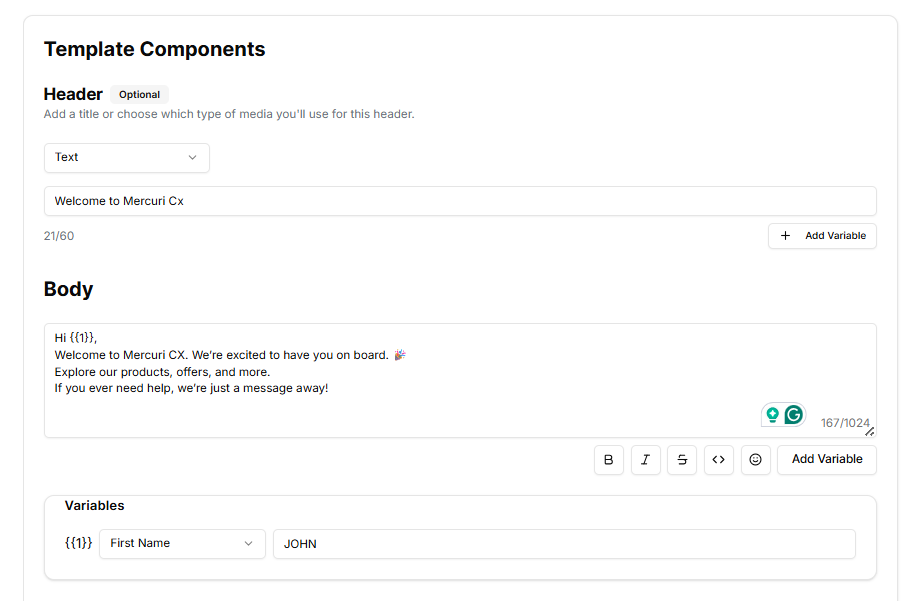
<figure><img src="/files/MNHttANT6kIPRglTViLj" alt=""><figcaption><p>Step 3 : Fill template components</p></figcaption></figure>

**Header (Optional):**

*Note: Headers can contain only one variable if needed, but in this case, a fixed title is considered.*

1. **Type:** Text
2. **Example Text:**  `Mercuri CX`

\[[*Click here to explore different media that can be added to the header*](https://docs.mercuri.cx/features/automations/pages/y1Hhk9EVYdDwzdINHEqz#id-2.-template-header) ]&#x20;

**Body:**

1. Add the message content in the **Body** section of the template.
2. To include dynamic information like order ID or customer name, use the **"Add Variable"** button located at the right end of the Body field.&#x20;

Sample message :&#x20;

`Hi {{1}},`\
`Welcome to Mercuri CX. We’re excited to have you on board. 🎉`\
`Explore our products, offers, and more.`\
`If you ever need help, we’re just a message away!`&#x20;

**Variables** :&#x20;

Add a variable value to the corresponding placeholders with a sample value&#x20;

Note : Each `{{ }}`  is a placeholder that gets replaced dynamically during automation:

* `{{1}}` → Customer name

Note: Assign sample values for each variable before submitting for approval.

4. **Add Website and Contact  Us  Button**

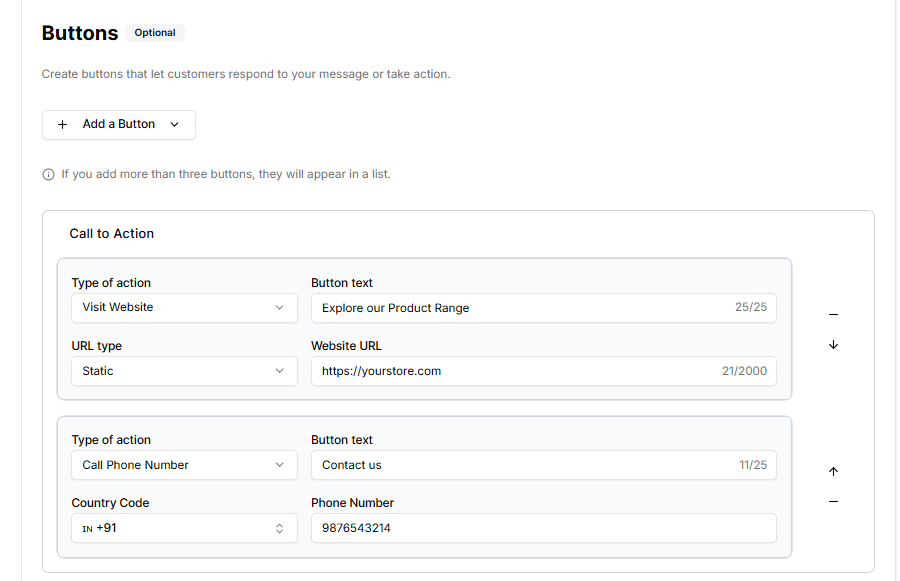
<figure><img src="/files/YhjjjY1mTuyxUoeNNJT6" alt=""><figcaption><p>Step 4 : Adding website and contact us buttton</p></figcaption></figure>

**Website Visit Button:**

1. Click the **Add Button** > select **Visit Website**.
2. Configure details for the Call to Action section as follows:
   * **Type of Action:** Visit website
   * **Button Text:** `Explore our Product Range`
   * **URL Type:** Static  [*\[*&#x43;lick here to learn more about the types of URLs.*\]*](/features/templates/whatsapp-templates/understand-whatsapp-template-components.md#different-url-types-in-call-to-action-buttons)
   * **Website URL:** `https://yourstore.com`

**Contact us Button:**

1. Click the **Add Button** > select **Call Phone Number**
2. Configure details for the Call to Action section as follows:
   * **Type of Action:**  Call Phone Number
   * **Button Text:** `Contact Us`
   * Select **Country Code** and enter the Phone number of **Customer support.**
3. Click on **Create template** after filling in all the required details.

[*\[Know more about the different buttons available in templates\]*](https://docs.mercuri.cx/features/automations/pages/y1Hhk9EVYdDwzdINHEqz#id-3.-template-buttons)

</details>

<details>

<summary><mark style="color:blue;"><strong>A.2 . Setting up the SMS Template</strong></mark></summary>

<figure><img src="/files/mKLh8XsdvUWIwH72fIgF" alt=""><figcaption></figcaption></figure>

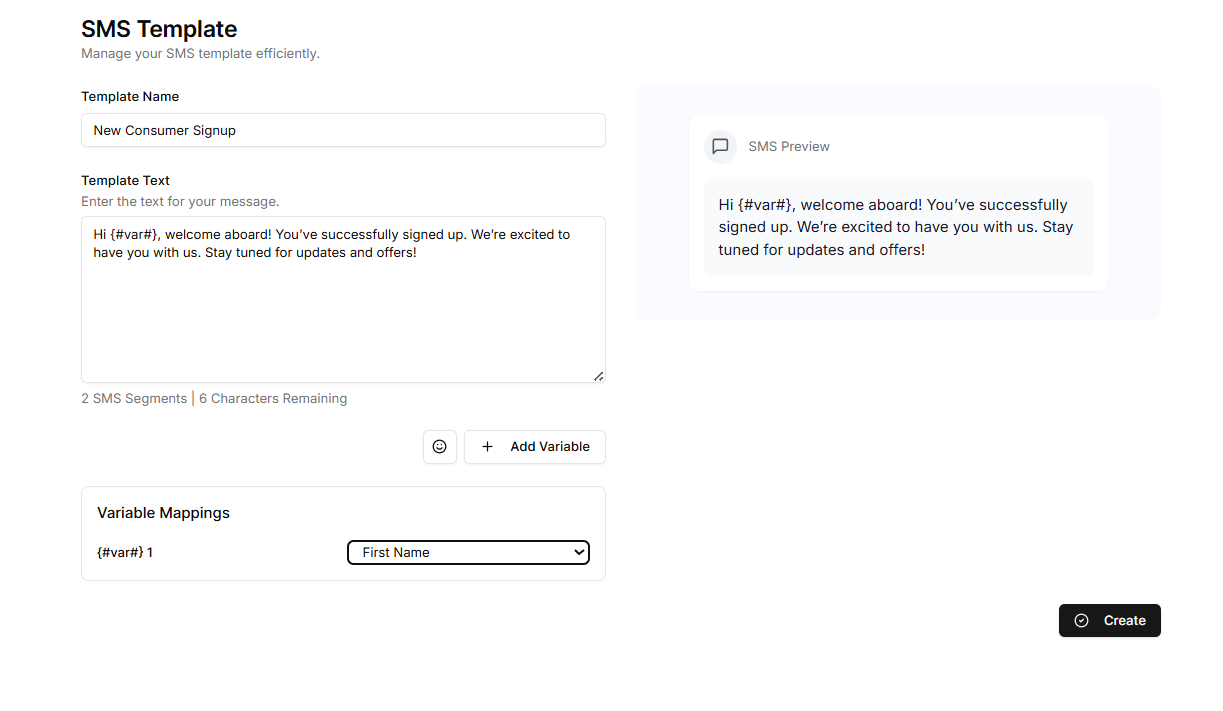
1. Go to the **Templates** section in the left-hand menu of the Mercuri dashboard, and select **SMS**.
2. In the top-right corner, click **Create Template** to begin.

**3. Fill in Template Details**

You’ll be directed to the SMS template creation form. Fill in the following:

* **Template Name**: Enter a short, descriptive title so it’s easy to identify the purpose of the message.

**Example**

```
New Consumer Signup
```

* **Template Text**:\
  Craft a clear and concise message (within 160 characters). You can personalize it using dynamic variables.<br>
* Click the **Add Variable** button in the bottom-right corner of the body section to insert placeholders.

  **Example:**

  ```
   Hi {#var#}, welcome aboard! You’ve successfully signed up. We’re excited to have you with us. Stay tuned for updates and offers!
  ```

**4. Variable Mapping**

Map each `{#var#}` to the actual data fields, like consumer name **.**

**5. Preview**

View the **SMS Preview** to see how the final message will appear to customers.

**6. Save the Template**

Click **Create** to save your SMS template. It will now be available to use in campaigns, automations, or workflows.

</details>

### B. Adding the WhatsApp /SMS template to the Automated workflow

* Go to the **Automation** section in the dashboard.
* Click on **Create Automation**.
* Choose the **automation type** as `New Customer Signups` from the list.
* Select the preferred communication channel as **WhatsApp/ SMS ,** for delivering the automated message.
* Choose the approved `new-signup_welcome` template that we created in earlier steps.

***

### Video Resources

<mark style="color:blue;">**SMS Automation**</mark>&#x20;

{% embed url="<https://youtu.be/BN5wBlE7O1Q>" %}


---

# Agent Instructions: Querying This Documentation

If you need additional information that is not directly available in this page, you can query the documentation dynamically by asking a question.

Perform an HTTP GET request on the current page URL with the `ask` query parameter:

```
GET https://docs.mercuri.cx/features/automations/automated-workflow-for-customer-signup.md?ask=<question>
```

The question should be specific, self-contained, and written in natural language.
The response will contain a direct answer to the question and relevant excerpts and sources from the documentation.

Use this mechanism when the answer is not explicitly present in the current page, you need clarification or additional context, or you want to retrieve related documentation sections.