> For the complete documentation index, see [llms.txt](https://docs.mercuri.cx/llms.txt). Markdown versions of documentation pages are available by appending `.md` to page URLs; this page is available as [Markdown](https://docs.mercuri.cx/features/automations/automated-workflow-for-booking-related-events/booking-canceled-template.md).

# Booking Canceled Template

### Use Case: Customer Cancels a Reservation or Appointment

When a customer cancels a reservation or appointment, sending a quick WhatsApp / SMS notification can confirm the cancellation and let them know about rescheduling options.

### Steps involved in setting up an Automated Workflow

{% hint style="info" %}
If you have already set up the WhatsApp / SMS template for the **Booking Canceled** event, then jump to this [section](#b.-adding-the-whatsapp-sms-template-to-the-automated-workflow).&#x20;
{% endhint %}

<details>

<summary><mark style="color:blue;"><strong>A.1.Setting up WhatsApp Template</strong></mark></summary>

1. **Navigate to WhatsApp Templates**

<figure><img src="/files/SFuB5eiJN1zMtMmrWo02" alt=""><figcaption><p>Step 1  : <strong>Navigate to WhatsApp Templates</strong></p></figcaption></figure>

&#x20;1\. Go to **Templates > WhatsApp** in the Mercuri CX dashboard.

2. Click **Create Template**.

3. Select the **WhatsApp Account** that will be used to send out WhatsApp messages.

4. **Configure Template Details**

<figure><img src="/files/dSyKVrxKY0kAPpUwFFCk" alt=""><figcaption><p>Step 2 : Confirm Template details</p></figcaption></figure>

**Fill in the basic template info:**

* **Template Name:** `booking_canceled_template` (Use an easy name to identify later)
* **Language:** `English` (or as per your customer base)
* **Category:** `UTILITY` (since it’s an informational message) &#x20;

[\[ *Understand the different categories of WhatsApp templates*\]](https://docs.mercuri.cx/features/automations/automated-workflow-for-booking-related-events/pages/y1Hhk9EVYdDwzdINHEqz#id-1.-template-category)

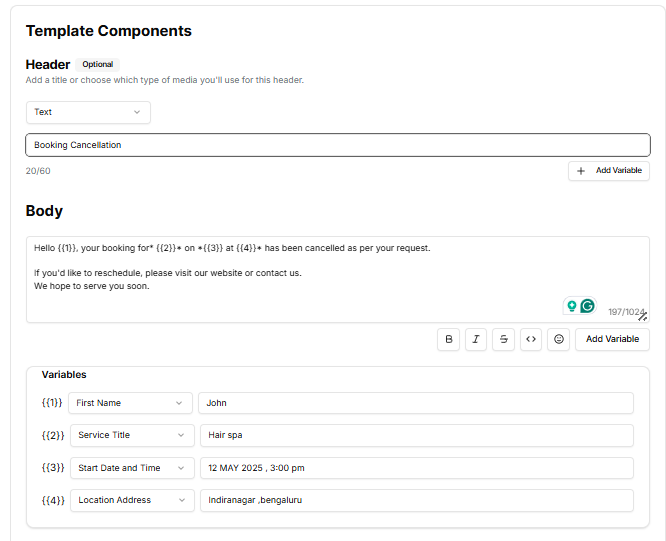
3. **Fill Template Components**

<figure><img src="/files/ZWQzzNLUuRULtnzo4OUK" alt=""><figcaption><p>Step 3 : Template Components</p></figcaption></figure>

**Header (Optional):**

*Note: Headers can contain only one variable if needed, but in this case, a fixed title is considered.*

1. **Type:** Text
2. **Example Text:** `Booking Cancelled`

[\[*Click here to explore different media that can be added to the header* \] ](https://docs.mercuri.cx/features/automations/automated-workflow-for-booking-related-events/pages/y1Hhk9EVYdDwzdINHEqz#id-2.-template-header)

**Body:**

1. Add the message content in the **Body** section of the template.
2. To include dynamic information like order ID or customer name, use the **"Add Variable"** button located at the right end of the Body field.&#x20;

***Sample message :***&#x20;

`Hello {{1}}, your booking for* {{2}}* on`` `*`{{3}} at {{4}}`*` ``has been cancelled as per your request.`

`If you'd like to reschedule, please visit our website or contact us.`\
`We hope to serve you soon.`

**Variables** :&#x20;

Add a variable value to the corresponding placeholders with a sample value&#x20;

Note: Each `{{ }}`  It is a placeholder that gets replaced dynamically during automation:

* `{{1}}` → Customer name
* `{{2}}` → service name
* `{{3}}` → Start Date and Time
* `{{4}}` → Location

Note: Assign sample values for each variable before submitting for approval.

3\. Click on **Create template** after filling in all the required details.

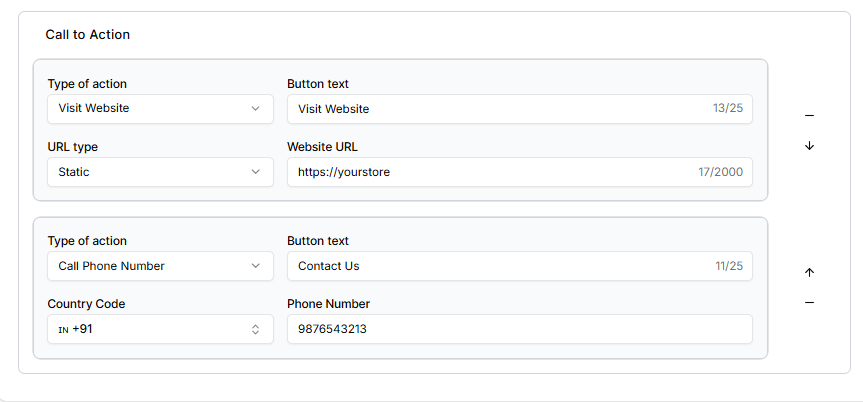
### 4. Add a Visit Website and Contact Us button

<figure><img src="/files/Av5gdtv7zCP7izAacCuz" alt=""><figcaption><p>Adding Buttons</p></figcaption></figure>

[*\[Know more about the different buttons available in templates\]*](https://docs.mercuri.cx/features/automations/automated-workflow-for-booking-related-events/pages/y1Hhk9EVYdDwzdINHEqz#id-3.-template-buttons)

**Visit Website Button:**&#x20;

1. Click the **Add Button** > select **Visit Website**.
2. Configure details for the Call to Action section as follows:
   * **Type of Action:** Visit website
   * **Button Text:** `Visit Website`
   * **URL Type:** Static[  *\[*&#x43;lick here to learn more about the types of URLs.*\]*](/features/templates/whatsapp-templates/understand-whatsapp-template-components.md#different-url-types-in-call-to-action-buttons)
   * **Website URL:** `https://yourstore.com`

**Contact us Button:**

1. Click the **Add Button** > select **Call Phone Number**
2. Configure details for the Call to Action section as follows:
   * **Type of Action:**  Call Phone Number
   * **Button Text:** `Contact Us`
   * Select **Country Code** and enter the Phone number of **Customer support.**
   * Click on **Create template** after filling in all the required details.

</details>

<details>

<summary><mark style="color:blue;"><strong>A.2.Setting up SMS Template</strong></mark></summary>

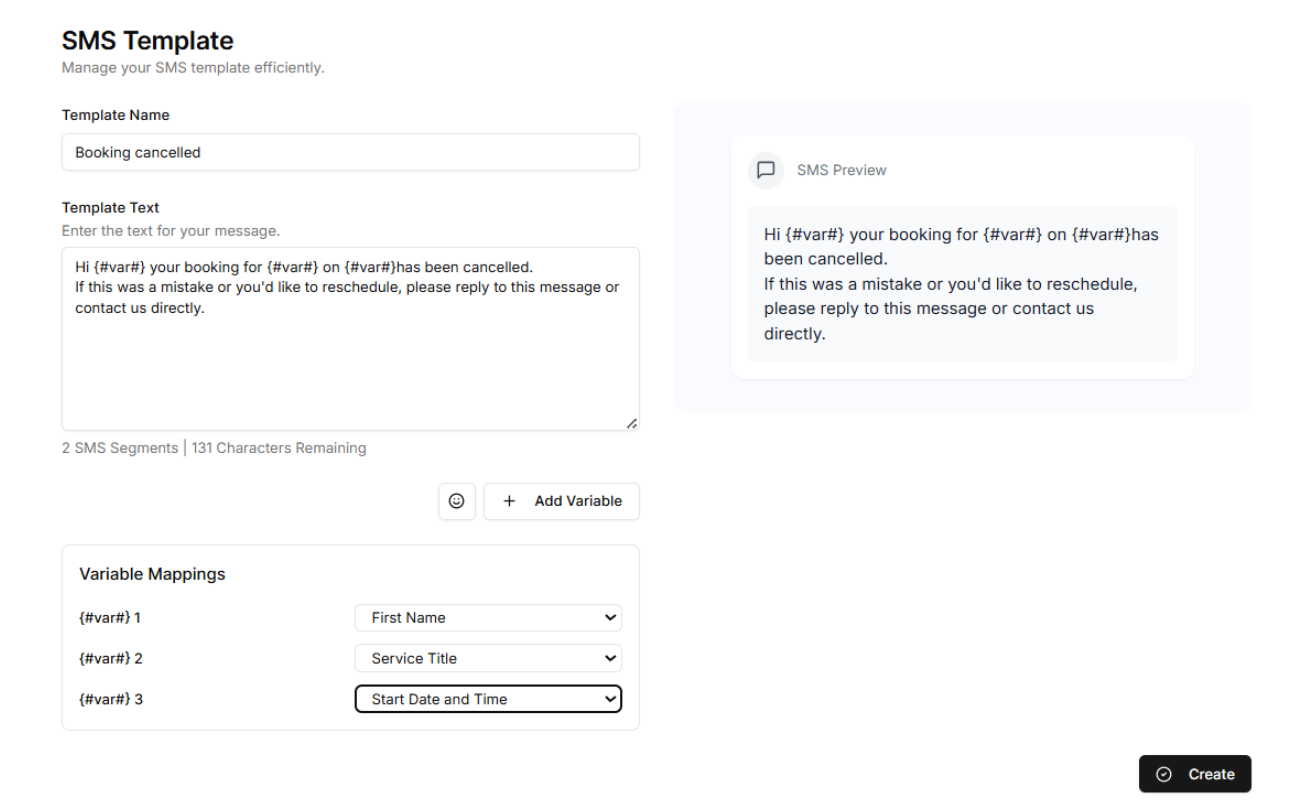
<figure><img src="/files/t1YAhwkvXTUobEC83aYH" alt=""><figcaption></figcaption></figure>

1. Go to the **Templates** section in the left-hand menu of the Mercuri dashboard, and select **SMS**.
2. In the top-right corner, click **Create Template** to begin.

**3. Fill in Template Details**

You’ll be directed to the SMS template creation form. Fill in the following:

* **Template Name**: Enter a short, descriptive title so it’s easy to identify the purpose of the message.

**Example**

```
booking cancelled
```

* **Template Text**:\
  Craft a clear and concise message (within 160 characters). You can personalize it using dynamic variables.<br>
* Click the **Add Variable** button in the bottom-right corner of the body section to insert placeholders.

  **Example:**

  ```
  Hi {#var#} your booking for {#var#} on {#var#}has been cancelled.
  If this was a mistake or you'd like to reschedule, please reply to this message or contact us directly.
  ```

**4. Variable Mapping**

Map each `{#var#}` to the actual data fields, like **customer name** , **service title, start date and time .**

**5. Preview**

View the **SMS Preview** to see how the final message will appear to customers.

**6. Save the Template**

Click **Create** to save your SMS template. It will now be available to use in campaigns, automations, or workflows.

</details>

### B. Adding the WhatsApp / SMS template to the Automated workflow

* Go to the **Automation** section in the dashboard.
* Click on **Create Automation**.
* Choose the **automation type** as `Booking Cancelled` from the list.
* Select the preferred communication channel as **WhatsApp/ SMS ,** for delivering the automated message.
* Choose the approved `booking_cancelled` template that we created in earlier steps.